
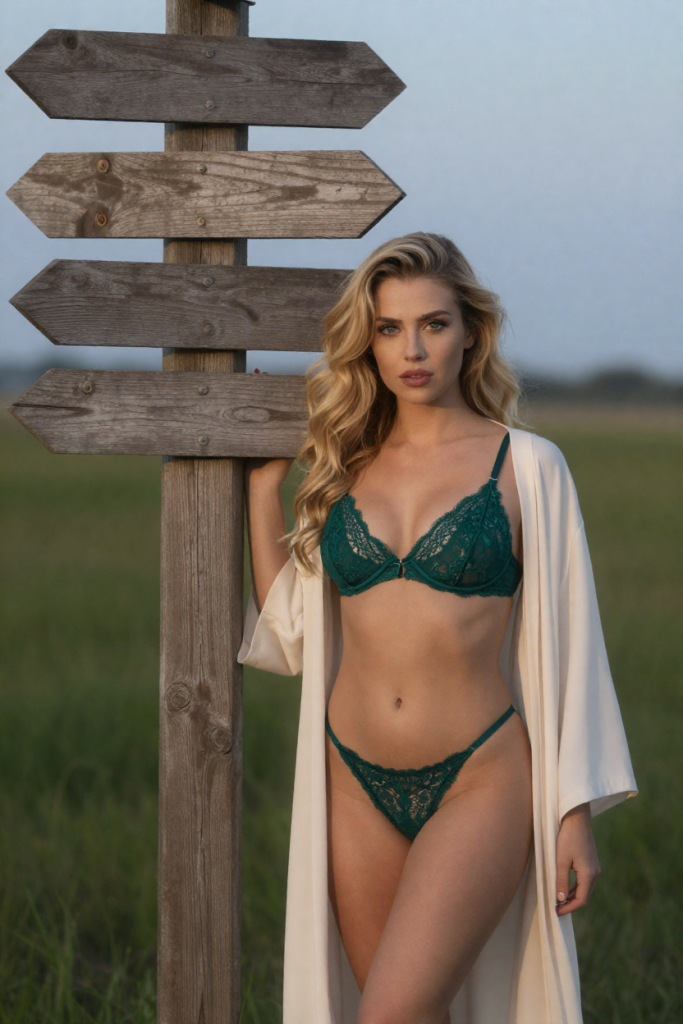
Every creator eventually writes a room so lovingly detailed that the woman becomes its smallest feature. The render obliges: chandeliers, bookcases, three windows, a cat. Set dressing is a real craft with a real budget, and in a prompt the budget is clauses. Spend them like a stage manager who knows the audience came for the actress.
The room in nouns
Write the setting as a short list of physical nouns: what she stands or sits on, what is immediately behind her, the surface to one side. Verbs and adjectives decorate; nouns place. “A tally-room desk”, “tall wooden shelves”, “a stone arch” — the renderer can build those. “An atmosphere of forgotten elegance” builds nothing and bills you for the attempt.
One hero prop
Choose a single prop to carry the set’s identity — the press, the chain, the knocker, the waypost — and let everything else be plain. One prop gives the frame a signature that survives a series and a brand that survives a feed. It also gives the model exactly one complicated object to get right. Two hero props is a negotiation; five is a jumble sale in which somewhere a woman is standing.
Backgrounds serve at a distance
State the background simpler than the subject: fewer objects, softer detail, darker or lighter by a stop. This is not minimalism for its own sake — video benches will later try to move this room, face swaps will try to light against it, and every downstream tool taxes a busy background. Dress the set once, plainly, and the whole production chain thanks you.